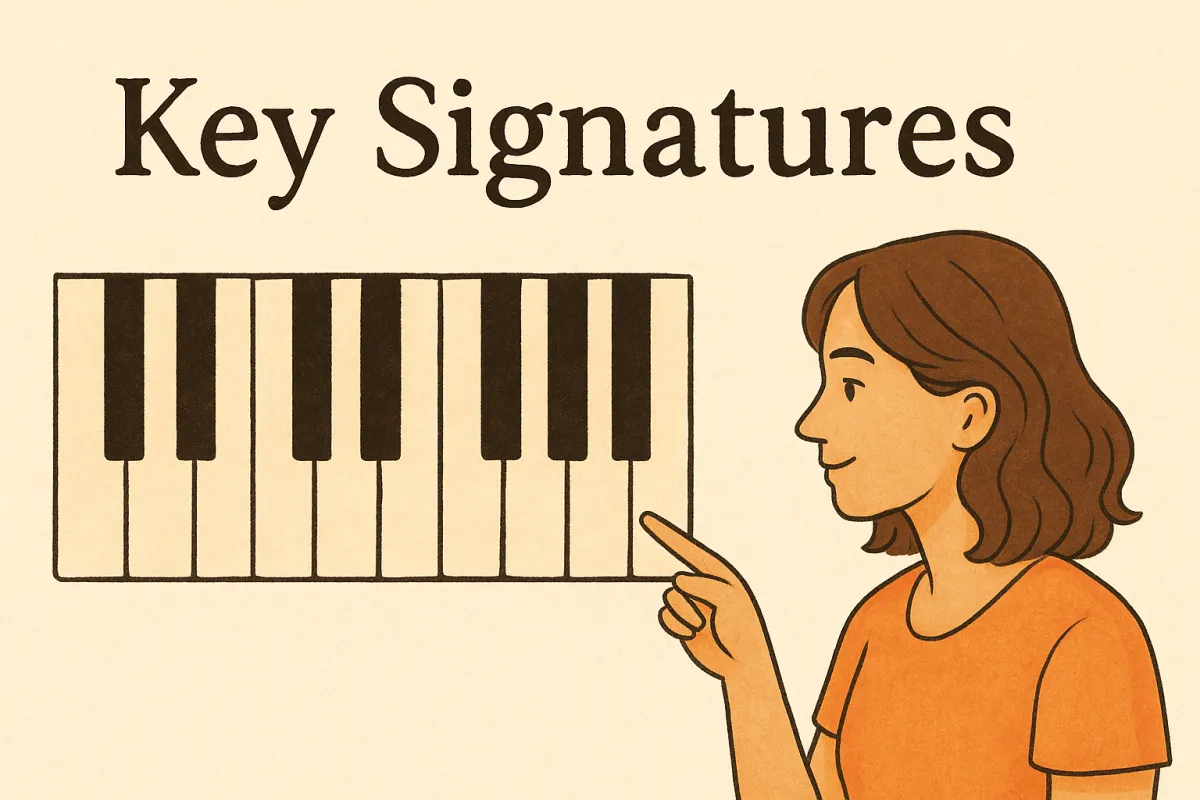
Key Signatures Piano - A Simple Guide That Actually Makes Sense
In this guide, we’ll look at key signatures from a practical point of view:
how they sound, how they relate to the home note, and how knowing them helps you recognize songs by ear and play more freely at the piano.
Watch: What Are Key Signatures and The Notes Within?
In this video, I explain how key signatures actually work, not as something you memorize from a chart, but as something you hear and feel every time you play.
What a Key Signature Really Tells You
There's more to key signatures than just a set of sharps and flats written on a piece of paper.
Key signatures help you narrow down what keys to play. It tells you what notes belong (7 notes instead of 12) and where a songs “home” is.
Every key has one home note.
For example:
C major → home note is C
G major → home note is G
F major → home note is F
Once you know your home note, everything you play from melodies, bass lines to chords becomes easier to understand.
You can hear when music moves away from home, and when it returns which is something that helps you immensely when playing by ear, and playing in general.
How to Hear the Key (Not Just Read It)
Most people try to remember key signatures visually:
“C major has no sharps, G major has one sharp, D major has two…”
But the faster way to truly learn keys is by hearing them.
Each key has a distinct "emotional colour":
C major → open, bright
G major → energetic
A major → hopeful
F major → calm and warm
D minor → dramatic or melancholic
When you train your ear to notice these subtle differences, you stop depending on written symbols and you start to feel the key instead.
A Quick Way to Understand Key Signatures
Here’s a practical rule that works better than memorizing a chart:
Every time you move up a fifth (C → G → D → A → E...), you add one sharp.
Every time you move down a fifth (C → F → B♭ → E♭ → A♭...), you add one flat.
That’s called the Circle of Fifths, and it’s one of the simplest ways to visualize how keys connect.
Once you see that pattern, it’s easy to understand why:
G major has 1 sharp (F#)
D major has 2 (F#, C#)
A major has 3 (F#, C#, G#), and so on.

How Key Signatures Connect to Playing by Ear
Understanding key signatures helps you:
Instantly identify the home note of any song
Predict which chords will likely appear (I, IV, V, vi...)
Recognize melodies faster by hearing the distance from home
Transpose easily into new keys
Inside The Ultimate Piano Course Bundle, this is one of the first ideas we build on - connecting what you see (key signatures) to what you hear (home notes and emotional colour).
When you understand the key signature, you stop thinking “notes on a staff”
and start hearing how music feels.
A Simple Exercise to Try
You can train this right now:
Pick any simple song you know (pop, movie theme, anything).
Hum the note that feels most like “home.”
Play that note on a piano or use a tuner app to check what it is.
If it sounds right throughout the song, that’s the home note
That sound is what the key signature is built around and now you know the key signature, not because you memorized it, but because you heard it.
Final Thought
Learning key signatures isn’t about memorizing black and white symbols.
It’s about understanding "where the sound in music belong".
When you can feel the difference between C, F, G, and A, you’re no longer just reading keys, you’re hearing them.
